
24/7 Emergency Gate Repair
A gate that fails at the wrong moment stops being a convenience problem and becomes an access problem. Whether it is stuck closed with a car behind it or stuck open with the property exposed, we dispatch around the clock across Portland and Vancouver, and we get the entrance under control first.
- 24/7 Dispatch
- Phone-Guided Manual Release
- Licensed in OR & WA
Call Now If Any of These Is Happening
These are the situations we treat as emergencies and dispatch for at any hour. If any one of them describes your gate right now, call rather than reading further.
- The gate is stuck closed and a vehicle is trapped
- The gate is stuck open and the property cannot be secured
- A vehicle has struck the gate, a post, or the operator
- A storm has dropped a limb on the gate or pulled a leaf off its hinges
- The power is out and you cannot find or operate the manual release
- The gate reverses on its own or ignores its safety eyes
- A burning smell or sparking at the operator cabinet: cut power at the breaker and step away
A gate that ignores its UL 325 safety devices can close on a person without stopping, and it should not run again until someone finds out why.
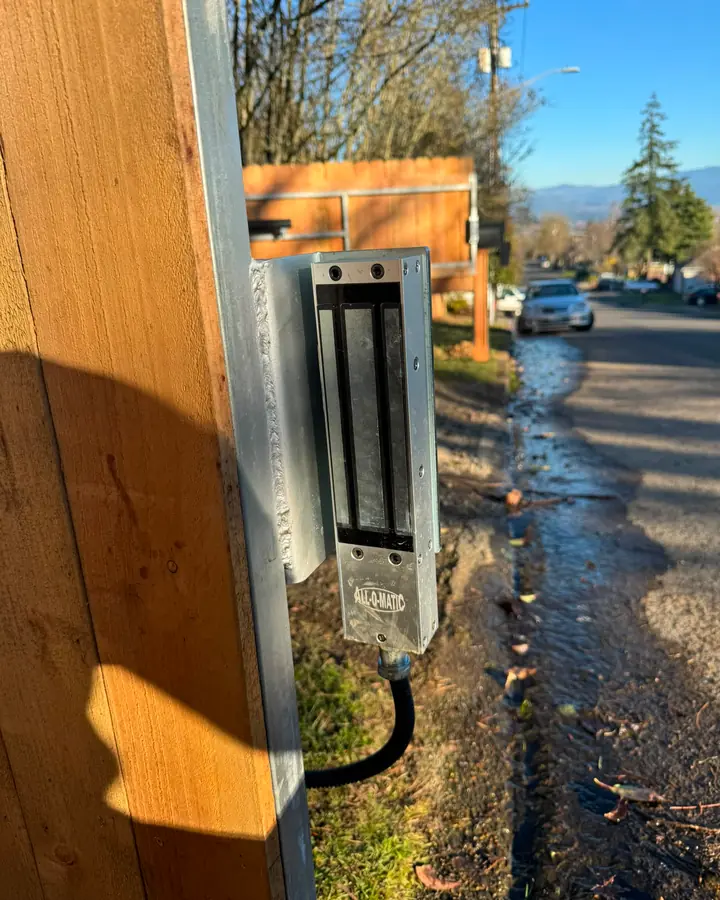
The Two Emergencies We See Most
A gate stuck closed with a car behind it and a gate stuck open with the property exposed make up most emergency calls. Each has its own first steps, and both are covered below.
Stuck Closed, With a Car Trapped
A gate that will not open failed at one specific point: a control board killed by a surge, a seized gear, a snapped chain, or a dead battery in a solar operator that has not seen sun since October. Our first move is usually over the phone: we help you find the manual release and free the vehicle before the truck is even loaded. Then we diagnose the failure itself, most often an opener or motor problem we can repair on the spot.
Stuck Open, With the Property Exposed
A gate frozen open is usually a sensing failure rather than a mechanical one. A limit switch that no longer tells the operator where "closed" is, a loop detector latched in the detect state, or a misaligned photo eye will each hold a gate open, because the operator believes closing is unsafe. We secure the opening first (a manually closed and locked gate beats an open one at 2am), then trace the fault through the loop detectors, photo eyes, and access hardware until the gate closes on its own again.
How the Manual Release Works, and When to Use It
Every gate operator has a way to disconnect the motor so the gate can be moved by hand.
On most sliding gate operators it is a keyed lever on the cabinet that disengages the drive from the chain; on swing gate actuators it is a release key or pin at the arm, one per leaf. Once disengaged, the gate should move with moderate hand pressure. If it will not, the problem is in the hardware, and forcing it makes the repair larger.
Two cautions. Cut power to the operator first, so the motor cannot start while the drive is disconnected. And respect gravity: on the steep driveways of Portland's West Hills, a released gate on a grade can roll under its own weight. Never release a gate that has been hit by a vehicle or is sagging on a failing hinge, because the drive may be the only thing still holding it upright.
When you call, we walk you through the release for your specific operator before anyone drives anywhere; freeing a trapped car over the phone turns a crisis into an ordinary repair appointment.
What to Tell Dispatch
- Slide or swing gate, and roughly how wide
- The operator brand if you can read the label
- Whether anyone or any vehicle is trapped
- Whether there is storm or impact damage
- Whether the property currently has power
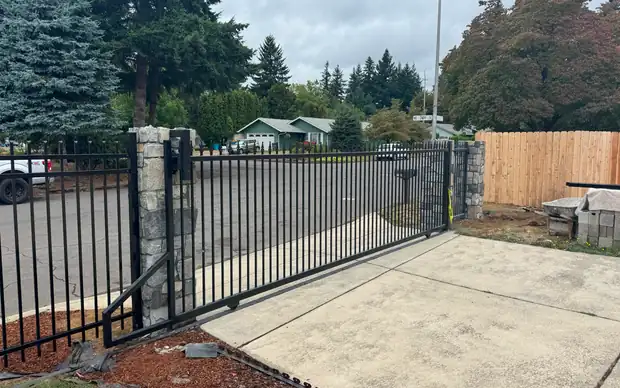
Storms, Outages, and What They Do to Gates
Most of our emergency calls cluster around weather. A November wind event drops fir limbs onto gates and pulls power lines down with them. Months of rain saturate the clay soil until a hinge post leans and a swing leaf drags. A hard January freeze thickens the grease in an already worn gear box.
Power outages deserve their own mention, because the outage itself is rarely the emergency. Operators with battery backup run a limited number of cycles; operators without it simply wait, and the manual release covers the gap. The damage usually comes when power returns: re-energizing a line sends a surge through everything connected to it, and gate control boards are a frequent casualty. On rural properties around Battle Ground and across the Vancouver side of the river, where outages run longer, we replace surge-killed boards every winter. A surge protector at the operator and a fall battery check, both part of our seasonal maintenance visits, prevent most of these calls entirely.
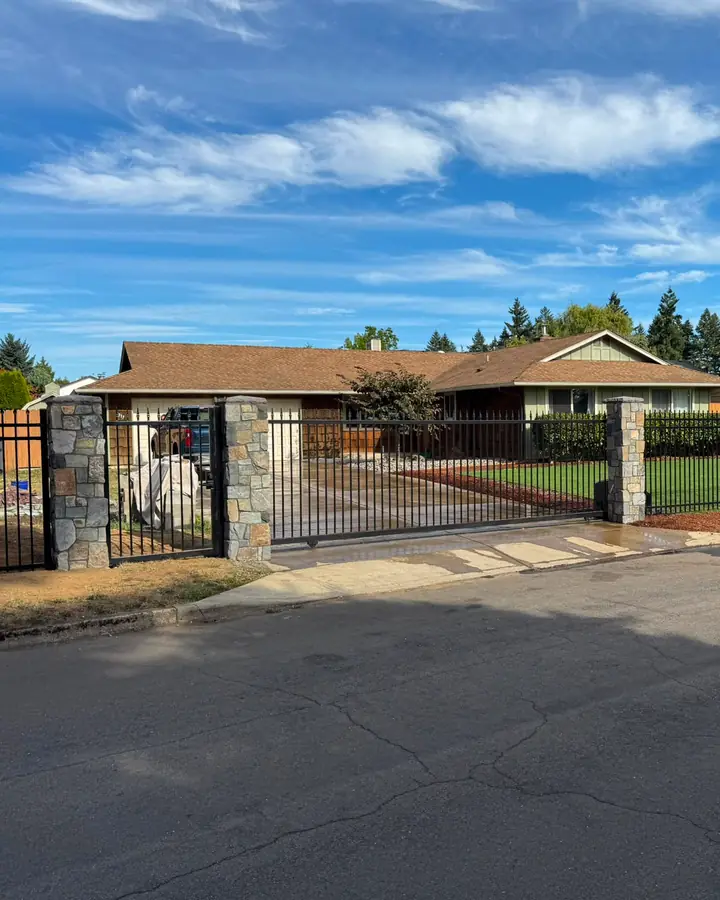
When a Vehicle Hits the Gate
Impact damage follows a pattern. On a sliding gate, the panel is knocked off its rollers and the track or guide posts bend; the gate may look repairable but will bind until the geometry is corrected: off-track and roller work we do routinely.
On a swing gate, the force travels into the hinges and the actuator arm. A bent arm is a part; a torn hinge weld is structural, and we bring the welder to you. On-site welding and frame reinforcement is often the difference between repairing an impacted gate and replacing it.
Our sequence on an impact call is deliberate: make the gate safe so nothing can fall, document the damage undisturbed for your insurance claim, secure the opening for the night, and plan the structural repair in daylight. We will also tell you plainly if the frame is beyond economical repair, an assessment that costs nothing and comes with the photographs to back it up.
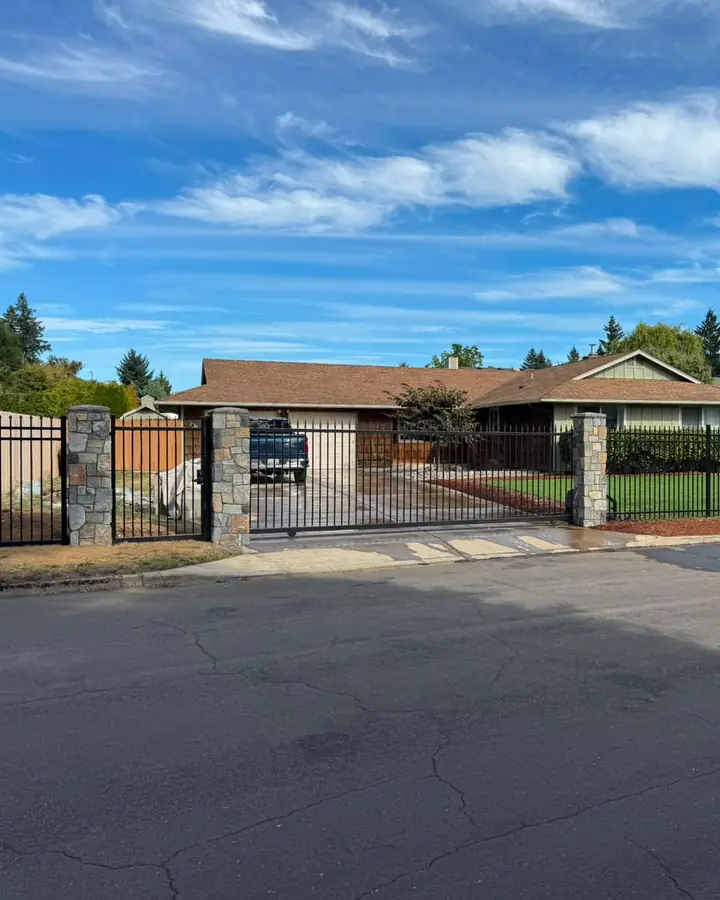
What Rides on the Emergency Truck
An emergency call only ends the emergency if the truck carries the part.
Ours stock the components behind most after-hours failures: control boards and capacitors, gear kits, limit switches, drive chain and tensioners, photo eyes, loop detectors, hinge barrels, and backup batteries. We service LiftMaster, DoorKing, Nice, Apollo, Viking, FAAC, BFT, US Automatic, Mighty Mule, Eagle, and Elite operators, so the board or gear your gate needs at 2am is usually already on the shelf. When a failure calls for a part we do not stock, we secure the gate that night and return with the component.
Emergency Gate Repair FAQ
A car is trapped behind our gate. What should we do first?
Call us. In most entrapment calls the fastest fix is the manual release, and we can usually walk you through finding and operating it over the phone before the truck arrives. If the release itself has failed or the gate is damaged, we dispatch immediately and put entrapment calls ahead of everything else on the board.
Is it safe to use the manual release myself?
Usually, with two cautions. Disconnect power to the operator first so the motor cannot start while the drive is disengaged, and think about slope, because a released gate on a graded driveway can roll on its own. Never release a gate that has been hit by a vehicle or is hanging from a damaged hinge, because the drive may be the only thing still holding it up.
The power is out and the gate will not move. Is that a repair problem?
Not by itself. Most operators simply wait for power to return, and models with battery backup will run a limited number of cycles without it. The repair problem usually arrives afterward: the surge that comes with re-energizing a line is one of the most common ways gate control boards fail in this region. If the gate does not wake up once power is restored, the board is the first thing we test.
A vehicle hit our gate. What should we do before you arrive?
Keep people away from the gate, leave the operator powered off, and photograph everything for the insurance claim: the gate, the track or hinges, the operator, and the vehicle. Do not try to force the gate closed. Our first job on arrival is making the gate safe and the opening securable; straightening and re-hanging come after that.
What counts as an emergency, and what can wait until morning?
Anything involving a trapped vehicle, a property that cannot be secured, a vehicle impact, or a burning smell from the operator cabinet is an emergency and worth a call at any hour. A gate that runs slowly, chatters, or needs a second button press is a real problem, but it is usually a scheduled-repair problem. Call during business hours and use the gate gently in the meantime.
A Gate Emergency Does Not Keep Business Hours.
Neither do we. One call reaches emergency dispatch on both sides of the river, any hour of any day.