
When Repair Is No Longer the Answer
New Gate Installation
Most gates that come to us marked for replacement leave with a repair instead. But some are genuinely past saving: rusted through, racked out of square, or hung on posts the soil has given up on. When that is the case, we show you why and design the replacement around the site.
- Repair checked first
- Sliding & swing gates
- Operators sized to the gate
- Licensed in OR & WA
The Honest Math
When Replacement Actually Beats Repair
Our name is Interstate Gate Repair, not Interstate Gate Sales, and that ordering is deliberate.
Before we talk about a new gate, we run the same diagnosis as on any service call: what failed, why, and what it costs to put right. A cracked weld is a welding job. A derailed slider is usually an afternoon of track and roller work. A dead operator is very often a board, capacitor, or gear kit: faults our gate opener and motor repair visits resolve every week.
Replacement earns its recommendation when the failure is structural rather than local. A frame rusted through at several points along the bottom rail has lost its strength everywhere, not just where you can see daylight; patching one section with mobile welding only moves the load to the next weak point. The same logic applies to posts that wet clay soil has heaved past re-plumbing, and to operators so old that no one still makes their boards, gears, or remotes.
Signs a gate is past saving
- Bottom rails or pickets rusted through in multiple places, beyond structural re-welding
- Hinge or guide posts that have rotted, heaved, or leaned past re-plumbing
- A frame so far out of square that every re-hang sags again within a season
- An operator with no boards, gear kits, or receivers left on the market
- Repair invoices that keep returning to the same structural cause, year after year
- A gate type the site never suited, such as a swing leaf fighting an uphill driveway
Matching the Gate to the Site
Sliding or Swing: What Pacific Northwest Sites Ask For
Around here the deciding factors are slope and drainage, not snow. Standing water, moving clay soil, and eight months of drizzle are the conditions a gate lives with every year.
Sliding gates
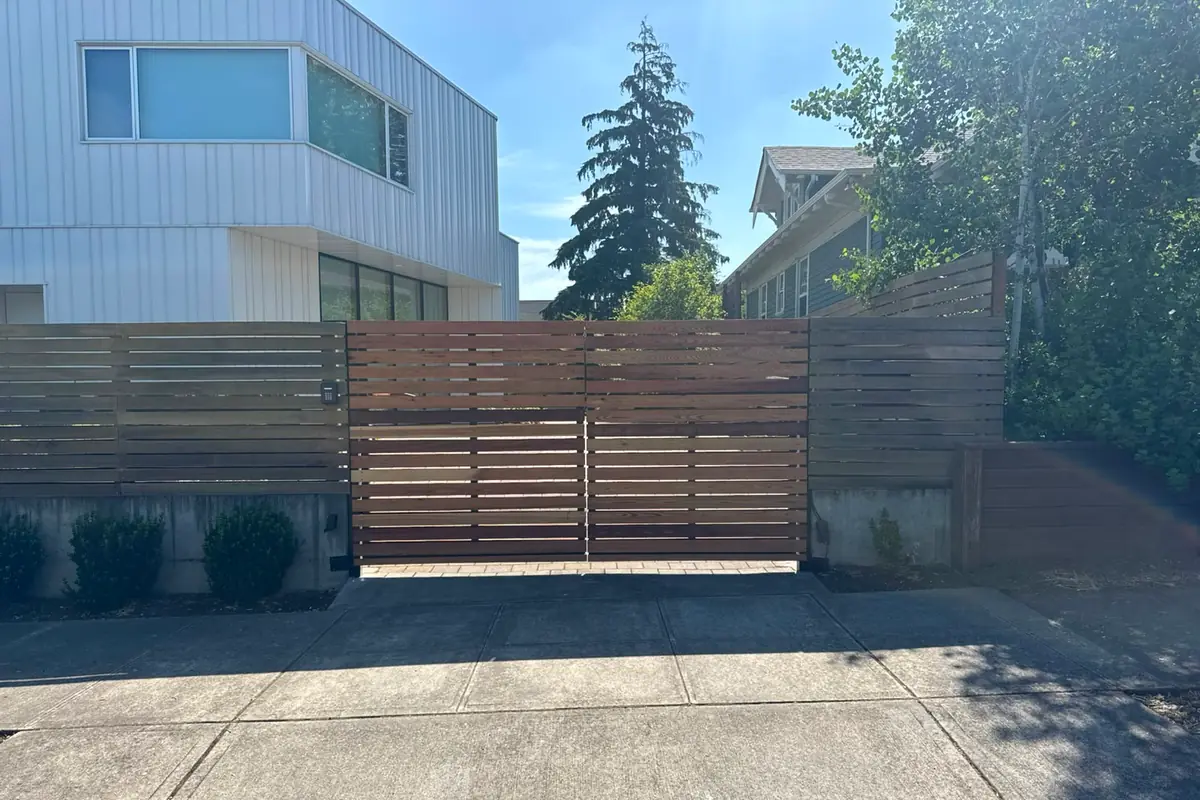
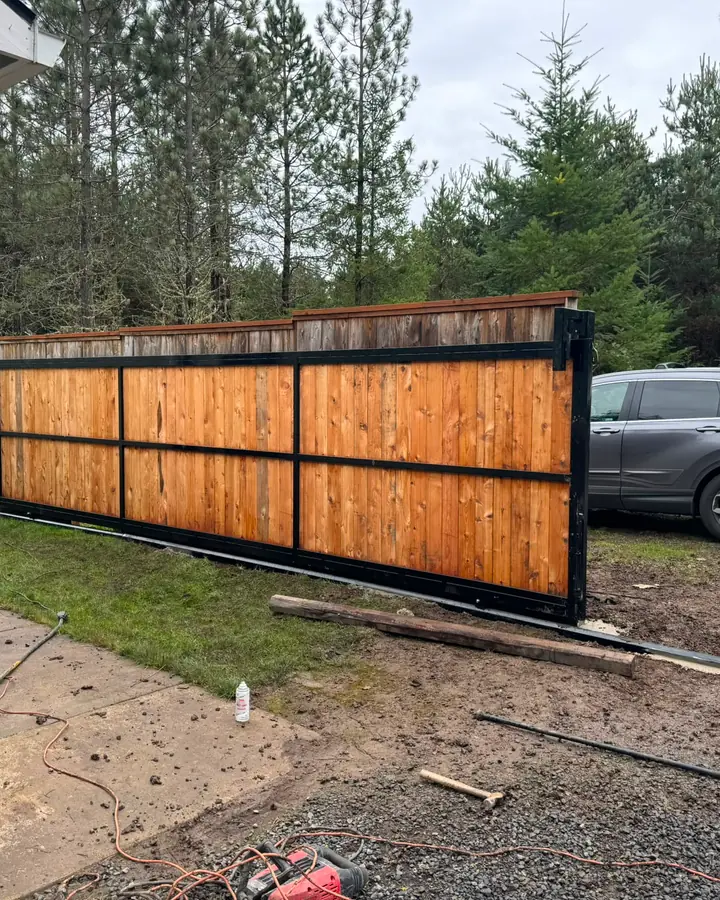
A slider needs a clear, level run along the fence line, but it does not care what the driveway does behind it, which makes it the usual answer for steep, short-setback driveways. On a V-track we grade for drainage so the channel does not become a winter gutter; where the ground stays wet, a cantilever design riding above the grade avoids the track entirely. Fall fir needles land somewhere either way, one reason we fold sliders into our seasonal maintenance plans.
Swing gates
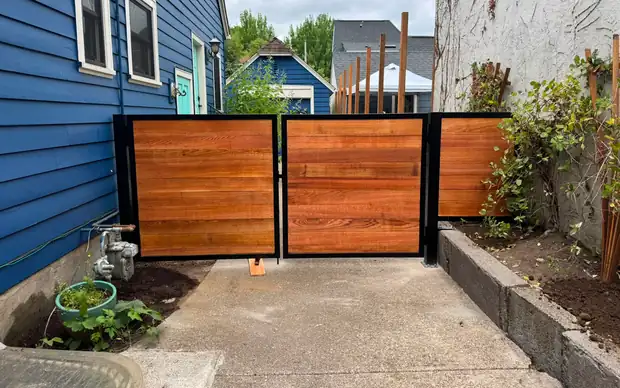
A swing gate needs room for the leaf to sweep its full arc over level ground, and it asks more of its posts: every pound of the leaf hangs on two hinges, in soil that swells each winter. We set swing posts in footings deep enough to shrug off that movement, because a shifted post is the root cause behind most of the sagging leaves our swing gate repair calls uncover. Where a grade climbs behind the gate line, we swing the leaf outward where sight lines allow or recommend a slider instead.
The Part Most Installs Get Wrong
Sizing the Operator to the Gate
An undersized operator works when new, then wears out its gears and motor years early running at its rated ceiling. We size from three numbers: the gate's weight, its length, and its cycles per day.
| Gate | What we look at | Typical equipment class |
|---|---|---|
| Light residential swing | Leaf weight and length, wind load on solid panels | Residential-duty linear actuator, single or dual leaf |
| Heavy or long swing | Steel or timber leaves, long moment arms | Articulated-arm or pad-mounted operator |
| Residential slider | Gate weight with hardware, track drag, slope of the run | Chain-driven slide operator with weight margin |
| Commercial or high-cycle | Cycles per day, gate mass, entrapment zones | Continuous-duty gear-driven operator |
We install and service operators from LiftMaster, DoorKing, Nice, Apollo, Viking, FAAC, and US Automatic. Every installation is commissioned to the UL 325 safety standard for gate operators, with photo eyes, safety edges, and correctly configured entrapment protection, and the gate itself is built to the ASTM F2200 construction standard. If you want keypads, telephone entry, or vehicle loops handled at the same time, our access control work covers new equipment as well as repairs.
How an Installation Runs
From Site Visit to Commissioning
A new gate project runs through four stages, and the first one is a repair check, because a gate that can be fixed for a fraction of the cost should be.
The repair check
We inspect the existing gate first. If it can be saved for meaningfully less than a replacement, we tell you and stop there. This visit ends the installation conversation more often than it starts one.
Site measurement and design
We measure slope, setback, drainage, and the travel or swing room available, then specify the gate type, material, operator, and access hardware. Sliding versus swing gets decided here, by the ground.
Fabrication and groundwork
Footings and posts go in first and cure fully, because a gate is only as straight as what it hangs on. Conduit for power and access wiring is trenched while the concrete sets.
Installation and walkthrough
We hang the gate, program the operator, install the safety devices, and cycle everything under load. Before we leave, you know how to use the manual release in a power outage, a lesson worth learning in daylight, not during a January storm.
We install on both sides of the river. In Portland, the work leans toward tight lots and steep westside driveways where a slider is often the only geometry that fits. North of the river, from Vancouver up to the acreage around Battle Ground, driveways get longer, gates get wider, and the questions shift to power runs and intercom wiring. Where an aging slider can still be saved, our sliding gate repair crew handles that instead.
Planning Questions
New Gate Installation Questions
Will you try to sell me a new gate when mine could be repaired?
No. Repair is our primary business, and every installation quote starts with a repair assessment. If a weld, a re-hang, or an operator rebuild will return your gate to reliable service, that is what we recommend, because it is usually the better use of your money. We only recommend replacement when we can show you the specific failed structure or obsolete equipment that makes repair a poor investment.
Should I choose a sliding gate or a swing gate?
The site usually decides. A swing gate needs level room for the leaf to sweep through its full arc, so a driveway that climbs immediately behind the gate line often rules it out. A sliding gate needs a clear, reasonably level run along the fence line for the gate to travel into. Setback from the street, drainage at the gate line, and how the ground moves in winter all factor into the recommendation we make after seeing the property.
How do you size the gate operator?
By the gate's weight, its length, and how many cycles per day it will see. Every operator is rated for a maximum gate weight and leaf length, and running one near its ceiling shortens the life of its gears and motor. We weigh the design, add margin for Pacific Northwest debris and moisture, and select an operator with capacity to spare. A busy commercial entrance gets a continuous-duty unit; a home driveway does not need one.
Can you install a gate on a sloped driveway?
Yes. Slope is one of the most common reasons we are called to replace a gate that was the wrong type for the site. On an uphill driveway a sliding gate that travels along the fence line is usually the cleaner answer. Where a swing gate must be used on a grade, the leaf can swing outward toward the street where codes and sight lines allow, or the hinge geometry can be set to lift the leaf as it opens.
Can my existing keypad, intercom, or remotes carry over to a new gate?
Often, yes. Keypads, telephone entry systems, and vehicle loops are separate from the gate and operator, and if they are in good working order we integrate them with the new equipment rather than replacing them. Remotes usually change because they pair with the operator's receiver, but we test everything on site and reuse whatever is serviceable.
Not Sure Whether It's Worth Fixing?
Ask for the repair check first. If your gate can be saved, we will save it; if it can't, we will show you exactly why. Portland and Vancouver.