
Keypad, Intercom & Access Control Repair
When a gate stops answering its keypad or intercom, the gate is usually healthy. A signal stopped arriving somewhere between the button and the operator, and the repair starts there.
- Keypads & telephone entry
- Loop detectors & photo eyes
- Both sides of the river
Signs the Access Control Failed, Not the Gate
Access control faults have a signature: the gate stops listening, stops seeing, or acts on signals nobody sent.
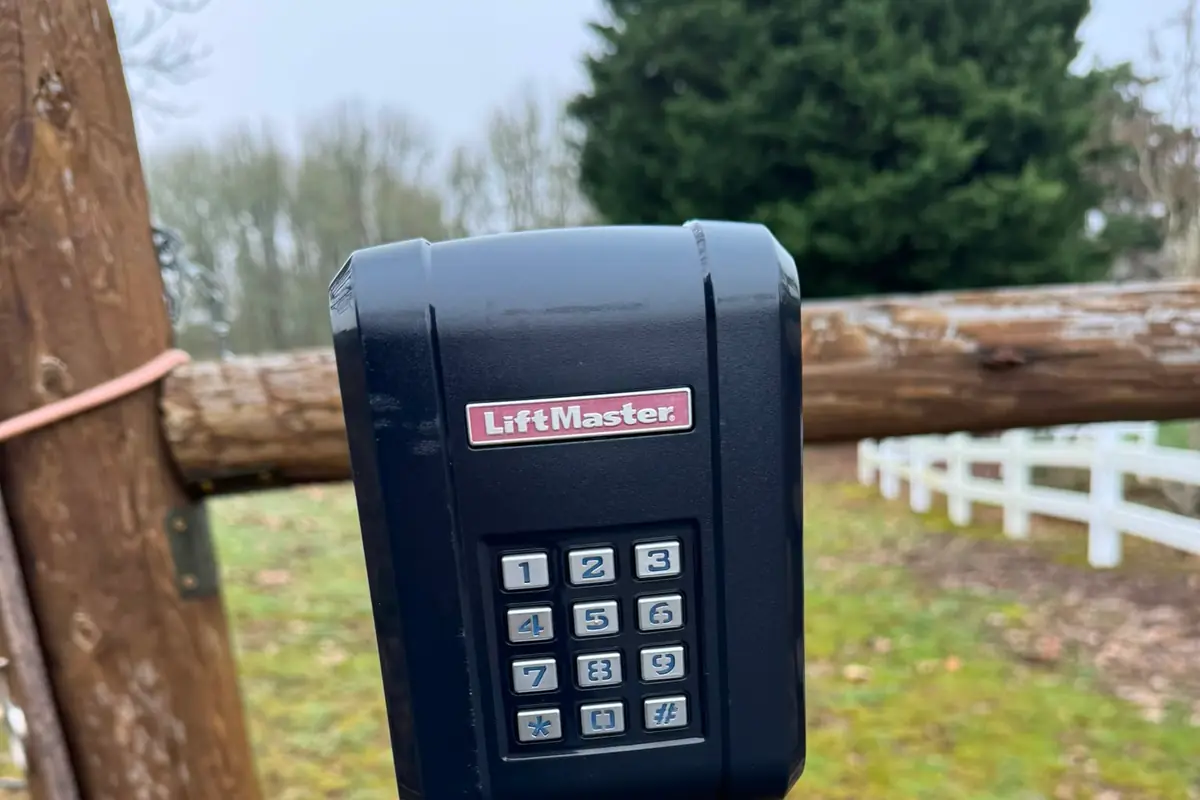
- The keypad lights and beeps, but a valid code opens nothing.
- Visitors hear you through the intercom, but you cannot hear them.
- Telephone entry stopped dialing out after a landline was cancelled.
- The gate opens on its own, often at night or in heavy rain.
- The gate will not close and the operator flashes a fault code.
- A fob reads only when touched to the reader, or the exit loop no longer senses departing cars.
Each symptom points to a class of component: a keypad that lights but does not command the gate has a broken output (a stuck relay or a corroded splice) while a gate that opens by itself is being false-triggered, usually by a waterlogged loop. The work overlaps with gate opener and control board repair, so we diagnose both on one visit.
Following the Signal From Button to Board
A keypad or intercom fault is found by following the signal along its path, from the device to the operator’s input, and testing at each point. The four checks below are done in this order.
Confirm power at the device
Low-voltage supplies fail quietly. A sagging transformer or corroded splice explains many dead-keypad calls, so we meter the device first.
Test the device's output
A keypad that accepts a code closes a relay. If the relay never closes, the device failed; if it closes and nothing moves, the fault is downstream.
Trace the wire run
Buried conduit between pedestal and operator spends eight months of the year wet here. We test it for breaks, shorts, and soaked splices.
Verify the operator's input
We jump the accessory terminal directly. If the gate moves, the repair stays in the access control; if not, it shifts to the control board.
The Devices We Repair, and How They Fail
Each type of access device has its own typical failures. The four groups below cover the devices we see most and what usually goes wrong with each.
Keypads & Telephone Entry
We service DoorKing, LiftMaster, Linear, and Nice panels. Membrane keys wear through, relays stick, and panels built for copper phone lines lose their line as carriers retire it. Many can move to a cellular gateway, a frequent fix in our commercial gate repair work at apartments and HOAs.
Card Readers & Cellular Intercoms
Proximity readers fade gradually: read range shrinks until fobs must touch the reader. Cellular intercoms fail at the antenna, power supply, or a carrier change; we test the radio and relay sides separately.
Loop Detectors & Exit Loops
A vehicle loop (a coil of wire in the pavement) senses metal above it. Freeze-thaw cracks the asphalt, water reaches the loop, and its detector goes blind or fires constantly. We test loops and replace failed EMX detector modules.
Photo Eyes & Safety Edges
Photo eyes from OPTEX and EMX watch the gate's path; safety edges sense pressure on its leading edge. Misalignment, fogged lenses, water in the edge channel, and cut wires are the usual findings, all repairable.
UL 325, Explained Plainly
UL 325 is the safety standard automatic gate operators are built and listed to. In plain terms, a machine strong enough to move a gate must notice a person or vehicle in its path and stop, so the standard requires external entrapment protection: photo eyes and safety edges.
Newer operators monitor those devices and refuse to close automatically when one fails; the gate is not broken, it is obeying its listing. We repair the device rather than bypass it, especially on the family driveways our residential gate repair page covers.
What Northwest Rain Does to Low-Voltage Electronics
Access control lives outdoors at the wettest point of the property. Rain pools in taped splices, condensation corrodes pedestal electronics one winter at a time, and photo eye lenses fog, grow moss, or catch fir needles after a windstorm.
We see the same patterns on Portland hillsides and at Vancouver entrances; the durable fix is sealed connectors, drip loops, and the seasonal cleaning our gate maintenance plans cover.
Fixing the Electronics You Have
Access control is where replacement gets oversold, because a new panel is easier to quote than a diagnosis. Most failed systems have one failed stage, and we fix that stage and leave working hardware alone. When a failed sensor traps cars behind a gate, our 24/7 emergency gate repair line answers, on either side of the bridge.
Keypad & Access Control FAQ
Why does my keypad light up but the gate never moves?
Backlighting only proves the keypad has power. A valid code with no motion means the failure is downstream: a stuck relay, a corroded wire run, or a dead accessory input on the control board.
My telephone entry died when the landline was cancelled. Can it be saved?
Usually. Most panels were built around a copper phone line, and a cellular gateway can give the existing panel a wireless line. If the panel is truly obsolete, we say so and explain the options.
What is UL 325, and does my gate have to comply with it?
UL 325 is the safety standard gate operators are listed to. It requires photo eyes and safety edges to detect people and vehicles in the gate's path, and newer operators refuse to close automatically when a monitored device fails.
Why does my gate open by itself at night or in the rain?
Something is telling it to open: usually a vehicle loop whose cracked, water-soaked insulation false-triggers in damp weather. We isolate each input until we find the phantom signal.
Can you repair just the access control if the gate itself runs fine?
Yes. If the operator and hardware are healthy, we repair the keypad, intercom, or safety devices and leave the rest alone. Repair-first applies to the electronics as much as to the gate itself.
Gate Ignoring the Keypad? The Failure Has an Address.
We trace the signal from button to board and fix the one component that broke, at homes, complexes, and yards across the metro.