
Residential Gate Repair
A driveway gate rarely dies all at once. Hardware starts dragging, the motor strains, and the electronics give out last. We trace that sequence in reverse at your home, find the part that actually failed, and repair it, on either side of the river.
- Repair before replacement
- Licensed, bonded & insured in OR & WA
- Mobile: we come to you
What Homeowners Call Us About
Each of these complaints points to a short list of specific components, usually identifiable within the first few minutes of a visit.
- The gate opens but will not close, or closes partway and reverses.
- The opener hums or clicks without moving the gate.
- The remote works only from the last few feet of the driveway.
- One leaf of a double swing gate lags the other or meets it crooked.
- The gate drags, scrapes, or needs a shove to get started.
- The keypad works in dry weather and fails when it rains.
- The gate went dead after a power outage and never came back.
- The gate moves, but slower and louder than last year.
No item on that list writes the gate off. A gate that reverses on close usually has a misaligned photo eye or a mis-set force limit. A humming operator usually has a failed capacitor or a stripped gear kit, routine fixes detailed on our gate opener and motor repair page. A dragging gate is almost always hardware: a worn hinge barrel or flattened rollers.
Drag is the symptom to act on quickly: a motor that fights friction for months fails early.
The Failure Sequence We See on Most Driveways
Residential gates in this region decline in a consistent pattern, and it starts at the ground.
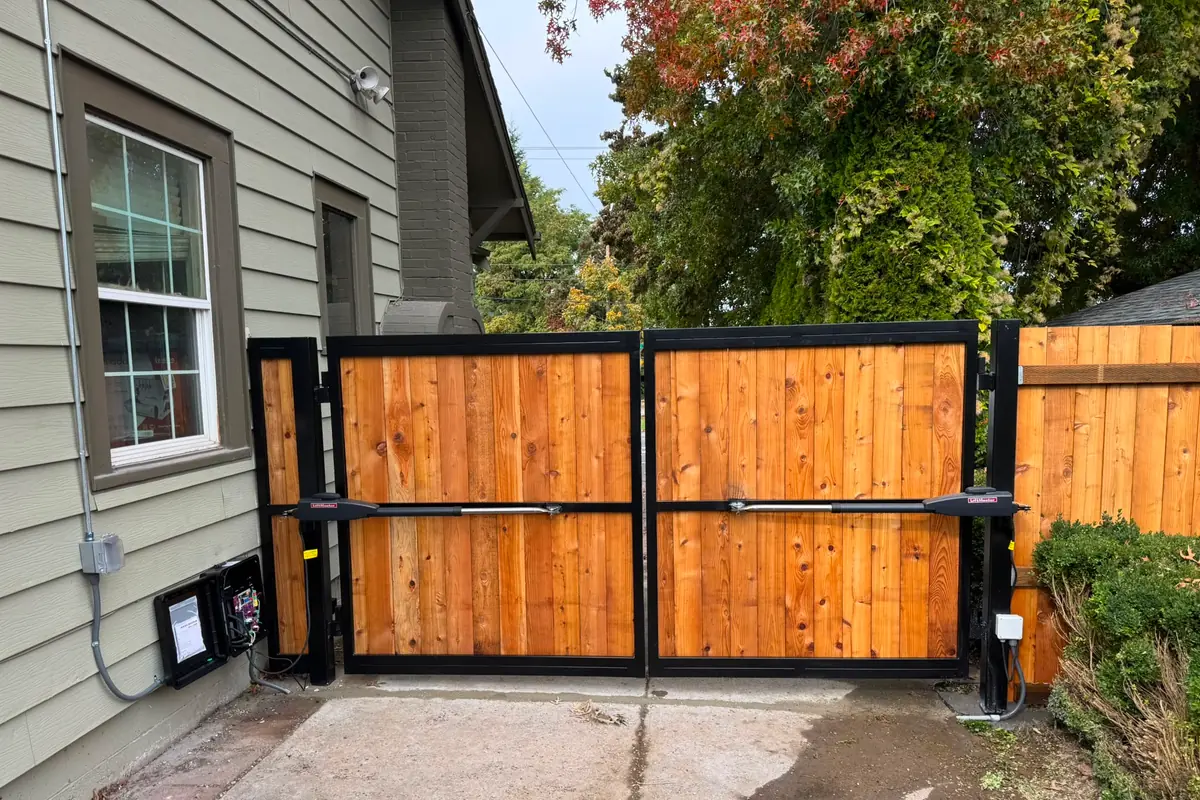
On swing gates, wet clay soil moves with the seasons; a post that shifts even slightly puts the leaf out of plumb, the hinges carry load at the wrong angle, and the leaf begins to sag. The mechanics are laid out on our swing gate repair page. On sliders, the track collects fir needles and grit every fall, the rollers grind that debris into a paste, and the gate gets harder to move with each pass, the progression covered under sliding gate repair.
The operator hides this decline by working harder, until something electrical lets go: the capacitor that starts the motor, the gear kit absorbing the extra load, or the control board itself. Winter outages accelerate the last step, because the surge that follows power restoration is hard on residential boards. When a gate strands you at night, our 24/7 emergency gate repair line covers it, but most of those calls are preventable if the drag is fixed while it is still just drag. That is why our repairs start at the hardware even when the complaint is electronic.
Safety Devices on a Family Driveway
An automatic gate is one of the heaviest moving objects on a residential property, and it moves on its own schedule. When children and dogs share the yard, entrapment protection matters more than any convenience feature.
Photo Eyes
An infrared beam across the gate path. Break the beam while the gate is closing and the operator stops and reverses. Eyes drift out of alignment, fog with condensation, and get blocked by growing shrubs, all fixable in one visit.
Safety Edges
A pressure-sensitive rubber strip on the gate's leading edge that reverses the gate on contact, the backup for anything a beam cannot see, which is exactly the height of a dog or a crouching child.
Force Settings & Reversal
Every modern operator has an internal obstruction sense. We test it against real resistance: tight enough to reverse on contact, not so tight that wind trips it.
UL 325, the safety standard governing gate operators, requires external entrapment protection on residential vehicular gates. Many older installations have none, or have devices disconnected after a nuisance stop. We test every safety device on every visit and repair or add photo eyes and safety edges through our keypad, intercom and access control service.
What a Service Visit Looks Like
A residential service visit follows the same four steps every time, from the walk-through to the safety check at the end, so you know what to expect before the truck arrives.
Walk-Through and History
We start by listening. When did the symptom appear, what changed around that time (a storm, an outage, a landscaping project) and does it happen every cycle or only some. The history narrows the diagnosis before a panel comes off.
Trace the Failure Chain
We test the chain in order until we find the failed link: power, control board, motor, drive, and hardware. Moving the gate by hand with the operator released separates a mechanical problem from an electrical one in about thirty seconds.
Repair From the Truck
Trucks carry the common failure parts for LiftMaster, DoorKing, Nice, Apollo, Viking, FAAC, BFT, US Automatic, Mighty Mule, GTO, Linear, Eagle, and Elite operators: control boards, gear kits, capacitors, limit switches, hinges, rollers, photo eyes, batteries, remotes. Most single-part failures are fixed the same visit.
Safety Check and Handover
Before we leave, we run full cycles, test the photo eyes and reversal, and show you the failed part next to its replacement. You also learn where the manual release is and how to use it in an outage.
Northwest Weather and Your Gate
Eight months of drizzle is hard on outdoor electronics. Moisture works into control boxes through failed gaskets and unsealed conduit, corroding terminals until a gate develops intermittent faults, the hardest kind to chase.
Moss gains a foothold on north-facing rails, fir needles pack sliding tracks each fall, and freeze-thaw cycles heave posts set in shallow footings. It is the ordinary background of gate work here, and the reason our seasonal gate maintenance plans follow the fall and winter failure calendar rather than a generic schedule.
Geography shapes the work too. The steep, narrow driveways in Portland's West Hills load swing gate hardware unevenly, since a leaf hung on a grade is always fighting gravity in one direction. Across the river in Vancouver and out toward the acreage of Battle Ground, long rural driveways mean more solar operators and gates that families depend on for keeping dogs in and traffic out. We cross the Interstate Bridge daily, so a Clark County address does not wait behind a Portland one.
Residential Gate Repair FAQ
My driveway gate opens but will not close. What usually causes that?
Usually a safety input, not the motor. The photo eyes that watch the gate path are the usual suspect: one has been bumped out of alignment, fogged by condensation, or blocked by a shrub that grew into the beam. The operator reads the interrupted beam as an obstruction and will not close on it. We realign or replace the eyes, clean the lenses, and verify the close cycle from the remote, the keypad, and the timer.
Is an automatic gate safe with kids and dogs in the yard?
It is safe when its entrapment protection actually works, and we test that on every visit. UL 325, the safety standard for gate operators, requires photo eyes and contact edges that stop and reverse the gate when something is in its path. On older installations these devices are often missing, disconnected, or wired around. We test what is there, tell you what is missing, and can add monitored photo eyes and safety edges to bring it up to current practice.
Do you repair solar-powered driveway gate openers?
Yes. Solar operators are common on rural driveways around the metro, and most of their failures are electrical: a battery that no longer holds charge after a few winters, a panel shaded by trees that have grown since installation, or corroded connections between panel, charge controller, and battery. We test each stage of that chain and replace only the part that failed. In our cloudy months a correctly sized panel and a healthy battery still run a residential gate reliably.
How long does a residential gate repair visit take?
Most single-failure repairs are finished in one visit because the common parts ride on the truck: control boards, gear kits, hinges, rollers, photo eyes, batteries, and remotes for the major brands. Diagnosis itself is usually quick, since residential gates fail in predictable patterns. If your operator needs a component that is not on the truck, we leave the gate secured and usable, order what is needed, and come back to finish the job.
When does replacing an old opener make more sense than repairing it?
We answer it the way an engineer would, not the way a salesman would. If the failure is a single component, a board, a gear kit, or a limit switch, repair almost always makes sense. If the operator has multiple failing systems, is undersized for the gate, or predates modern entrapment protection and cannot accept it, we show you the worn parts and explain why continued repair is money spent on borrowed time. That reasoning comes before any work begins.
Your Driveway Gate Should Just Work.
Tell us the symptom, and we will find the part that failed, at your home, on either side of the river.