
Viking Gate Operator Repair
Viking builds swing and slide operators that we find on driveways and commercial entrances all over this metro, and after enough service calls a pattern emerges: most failures come down to the control board, the safety device wiring, or wear in the motor and drive. We diagnose which one it is before we replace anything.
- Swing & slide operators
- Board-level diagnosis
- Portland & Vancouver
The Signs a Viking Operator Gives First
Viking operators telegraph their faults. The list below maps the common behaviors to the section of the machine responsible for them.
- You hear the motor try, but no movement follows
- The gate opens a short distance, stops, and reverses on nothing
- Remotes and keypads work intermittently or not at all
- The gate runs noticeably slower or strains near the end of travel
- The operator went silent after a power outage or lightning-season surge
- Status lights on the board blink a pattern that repeats
- The gate works in the morning but fails on wet afternoons
That last symptom is worth taking seriously. Faults that come and go with moisture almost always live in wiring and connections rather than in the motor, and they are among the most common findings on Viking calls in this climate.
Board-Level Faults: Reading What the Operator Is Telling You
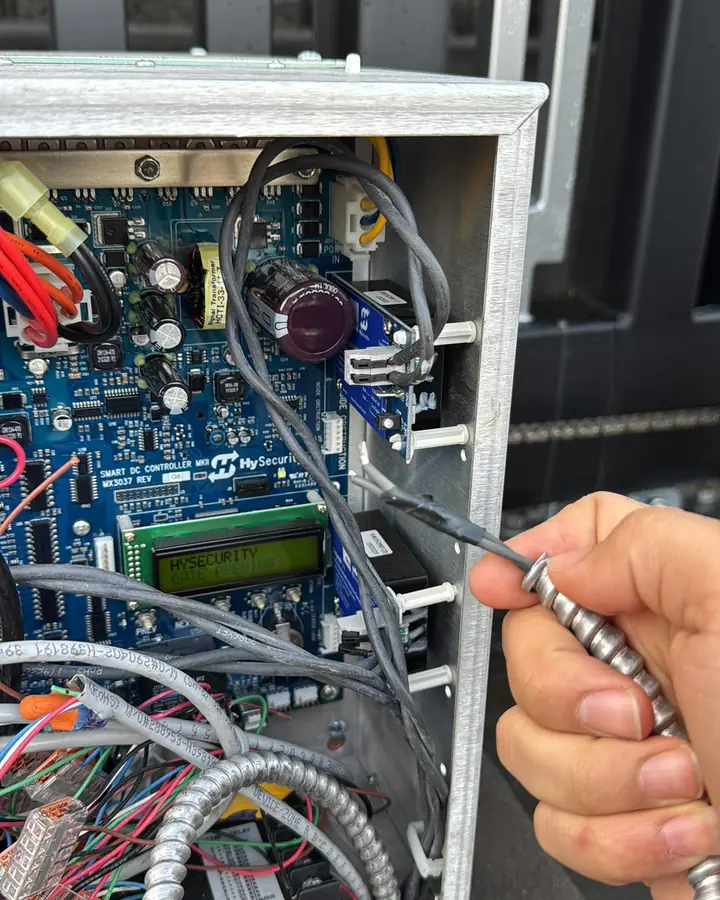
The control board in a Viking operator is the decision-maker: it reads the inputs, monitors the safety devices, and switches power to the motor.
When a gate misbehaves, the board is where the evidence collects, and Viking boards report their state through indicator lights and diagnostic patterns that we read before touching a single wire. A board that refuses to run the motor is often protecting the system from a fault somewhere else, and replacing it without finding that fault only transfers the problem to a new board.
The board failures we actually confirm tend to fall into a few groups. Surge damage is the big one here: winter outages end with a voltage spike when power returns, and an unprotected board absorbs it. Corrosion is the second: an operator cabinet that breathes damp air for eight months of the year grows oxide on terminals and connector pins until a circuit that tested fine in July drops out in November. The third is simple accessory overload, where a shorted keypad or sensor pulls down the board's low-voltage supply. This is the same discipline we apply across every brand on our gate opener and motor repair page; the difference on a Viking call is knowing this family's diagnostic language well enough to let the board do the talking.
Entrapment Devices and the Wiring That Fails First
Viking operators, like all modern gate operators, are designed around UL 325, the safety standard that requires working entrapment protection wherever a moving gate could trap a person.
In practice that means photo eyes across the opening, contact edges on the gate, and the monitored wiring that connects them to the board. When any of that chain fails, the operator does the safe thing: it stops, reverses, or refuses to run. A surprising share of “broken Viking gate” calls turn out to be a healthy operator obeying a failed safety circuit.
The wiring fails before the devices do. Photo eye leads chafe where they enter posts, buried runs take on water at splices, and connections corrode inside junction boxes that were never sealed against our rain. We trace the circuit, repair or re-terminate the wiring, realign the eyes, and then verify every entrapment device actually stops the gate before we leave. That UL 325 check is part of every operator visit, not an add-on. Keypads, intercoms, and loop detectors ride on the same low-voltage side of the board, and when the fault is in the access hardware rather than the safety chain, our keypad and intercom repair work picks it up.
Motor and Drive Wear on Swing and Slide Units
Downstream of the board, Viking's swing and slide operators wear the way any operator does: capacitors weaken until the motor hums instead of starting, drive components develop slack you can hear as a clunk at the start of travel, and bearings dry out and drag.
On swing units the arm linkage and its pivots take the load; on slide units it is the drive and the chain or gear interface. We isolate operator wear from gate wear by releasing the unit and moving the gate by hand. A leaf that drags on worn hinges belongs to our swing gate repair work, not to the operator, and fixing the operator alone would leave it straining against the same load that wore it out.
When Repair Stops Making Sense
Our default is repair, and on Viking equipment that default holds up well: boards, capacitors, batteries, and drive components are all serviceable, and a single failed part does not condemn the unit.
The judgment changes when failures start stacking: a surge-damaged board in a corroded cabinet with a worn drive is three repairs on one aging chassis, and at that point replacement is the honest recommendation. When we reach it, we show you the failed parts and lay out what a new operator installation would involve, without pressure in either direction. And because operator brands cluster by installer, the neighboring property often runs different equipment with the same symptoms. We service LiftMaster and DoorKing operators with the same board-first approach.
We carry the diagnostic tools and common electrical parts on the truck, so most Viking calls from Portland to Vancouver finish in one visit, and the same-day radius covers both sides of the river.
Viking Operator Repair Questions
I can hear my Viking operator hum, but the gate stays put. Why?
A hum means the board is calling for movement and the motor is receiving power, so the fault is downstream: a failed start capacitor, a worn drive coupling, or a gate bound so tightly the motor cannot overcome it. We separate those on site by releasing the operator and moving the gate by hand. If the gate glides freely, the problem lives in the operator; if it drags, the operator was never the problem.
Why does my Viking gate open partway and then reverse?
The operator believes it has hit an obstruction. Sometimes that is true: debris, a dragging hinge, a binding track. Just as often the entrapment circuit itself is at fault: a misaligned photo eye, a chafed sensor wire shorting intermittently, or a monitored device the board has stopped trusting. We test the gate hardware first, then each safety device, so the reversal is traced to its actual cause rather than tuned out.
Can the control board in a Viking operator be repaired, or does it have to be replaced?
It depends on what failed. Corroded terminals, loose connectors, and failed accessory fuses are repairable at the board without replacing it. Surge damage that has burned traces or components usually means a board swap, and we say so plainly when that is the finding. Either way, we address the cause, most often missing surge protection, so the new board does not fail the same way.
What is a UL 325 device check, and why do you do it on every Viking call?
UL 325 is the safety standard for gate operators, and it requires working entrapment protection (devices such as photo eyes and contact edges) in the areas where a moving gate could trap a person. Because so many Viking service calls trace back to these devices and their wiring, we verify that each one is present, wired correctly, and actually stops the gate before we close out the visit.
Is an older Viking operator worth repairing?
Usually, yes. If the chassis is sound and the failure is a board, a capacitor, a battery, or drive wear, repair restores the operator for a fraction of replacement. The judgment shifts when several systems are failing at once or the unit has been submerged or badly surge-damaged. In that case we lay the failed components out in front of you and explain what a replacement involves; the choice remains yours to make.
Viking Operator Acting Up? Let the Board Tell Us Why.
Board-first diagnosis, safety devices verified, most repairs done in one visit across Portland and Vancouver.