
Mighty Mule Gate Opener Repair
Mighty Mule openers are the units homeowners buy off the shelf and install themselves. They are low-voltage, battery-powered, and lighter-duty by design. On the right gate they run for years. On the wrong gate they fail young. We repair the ones worth repairing and tell you plainly when the money belongs in a heavier operator instead.
- Swing & slide units
- Battery & solar charging
- Portland & Vancouver
Symptoms We See on Mighty Mule Openers
Each of these points to a specific part of a fairly simple system: a battery, its charger, a control board, and an actuator. The diagnosis is a matter of working through them in order.
- The gate opens slowly, stops partway, or gives up before it latches
- The unit went quiet after a power outage and never recovered
- A solar-charged opener works in summer but fades by November
- The control box clicks when you press the remote, but the arm does not move
- The actuator arm hums, grinds, or moves the gate in surges
- Remote range has shrunk, or the keypad works only intermittently
- The gate reverses on nothing, or refuses to close all the way
If your opener is a different make, the same diagnostic sequence applies. Our gate opener and motor repair page covers the full range of operators we service, from light residential units to commercial equipment.
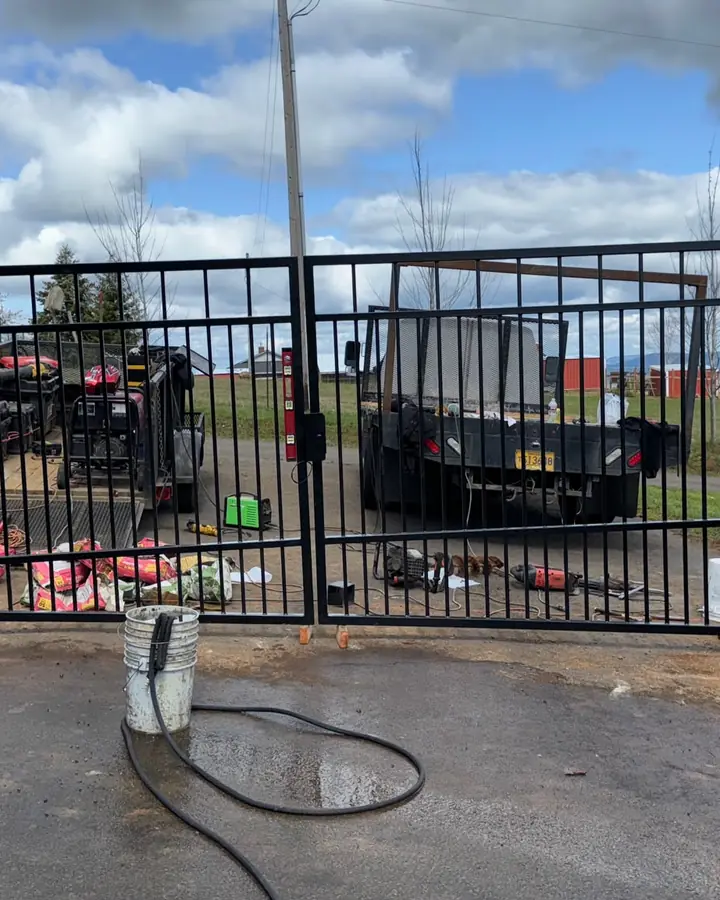
The Battery Carries the Whole System
A Mighty Mule does not run directly off house power. It runs off a 12-volt battery, and the plug-in transformer or solar panel exists only to keep that battery charged.
This is worth understanding because it explains the most common failure we see: the charger quits, the battery keeps the gate moving for days or weeks on stored energy, and then the gate slows, strains, and stops, long after the actual failure happened. We test the battery under load, measure the charging voltage reaching it, and trace the low-voltage wire run out to the gate, because the failure can be at either end or anywhere along the trench between them.
Batteries also simply age. One that has been deeply discharged through a winter outage often will not hold useful capacity again even after the charger is restored, which is why a gate that died during a storm frequently needs a battery, not a board. Our guide to gate failures after a power outage walks through that sequence in more detail.
Control Boards, Actuator Arms, and Moisture
When power checks out, attention moves to the control board and the actuator.
The board lives in a plastic housing at the gate post, and after enough Pacific Northwest winters we regularly find condensation, corroded terminals, or slug and insect intrusion inside. Sometimes cleaning and re-terminating the connections revives it; when the board itself has failed, we replace it if a replacement is available and the rest of the unit justifies it.
The actuator arm is the muscle of a swing unit, and it is the part that wears in proportion to how hard the gate makes it work. A gate with dragging hinges or a dropped leaf forces the arm to grind through resistance on every cycle, and the arm's gears strip long before their time. That is why we check the gate hardware before condemning the opener. A swing gate hinge repair often saves the actuator that was being blamed for the problem.
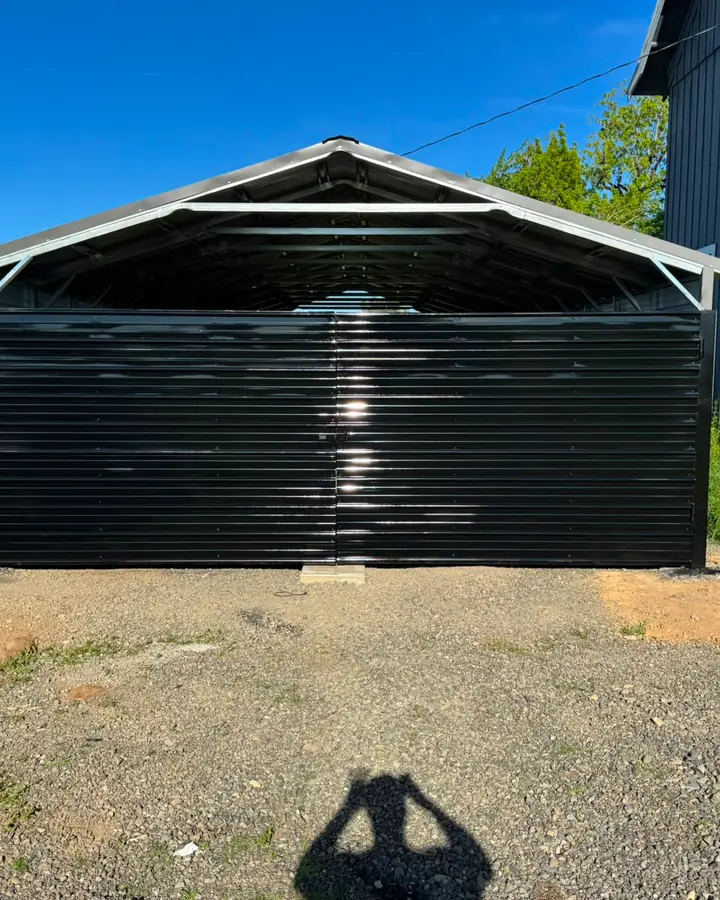
DIY Installs Meet a Wet Climate
Most of the Mighty Mule units we service were installed by the homeowner, and there is nothing wrong with that.
They are sold for exactly that purpose. But the installs we visit tend to share a few shortcuts: low-voltage wire runs that are too thin for their length, connections twisted and taped rather than sealed, and solar panels mounted under a fir canopy that blocks most of the light they need. Around here the solar problem is seasonal and predictable. A panel that keeps the battery topped up through July cannot do it through eight months of gray, and the gate starts failing in November on the wooded acreage around Battle Ground and throughout rural Clark County, where these units are most common.
None of this condemns the opener. Upsizing a wire run, sealing the connections, relocating a panel into real sun, or switching a starved solar system to a transformer are all ordinary repairs, and we make them on both sides of the river, from acreage driveways in Washington to backyard gates in Portland.
The Line Between a Fix and a False Economy
Here is the honest arithmetic. A Mighty Mule on a light, well-hung gate that failed at one component (a battery, a transformer, a remote, an arm) is a sensible repair, and we finish most of them in a single visit.
A Mighty Mule that has been repaired twice already, strains audibly on a heavy steel or long wooden gate, or protects an entrance that cycles all day is a different case. The unit is working past its class, and each repair only rents time until the next failure.
In that second case we say so, show you the worn parts, and lay out the alternative: a heavier-duty operator sized to the gate. That can mean stepping up to a residential unit from a maker such as LiftMaster (our LiftMaster gate repair page describes that equipment from the service side) or, where the gate itself is at the end of its life, a full replacement through our new gate installation service. Either way the recommendation arrives with the worn parts laid out where you can inspect them, and you make the final call.
Mighty Mule Repair Questions
Why does my Mighty Mule gate open slowly or only partway?
On a battery-powered opener, a slow or partial cycle almost always means the battery is weak or its charging source has stopped keeping up. Because the charger has one job, refilling the battery, its failure hides for days while stored energy keeps the gate moving; then the fade begins. We load-test the battery, measure what charging voltage actually arrives at it, and replace whichever half of the system gave out.
Can you actually repair a Mighty Mule opener, or do you only replace them?
We repair them when the repair makes sense. Batteries, transformers, remotes, receivers, and actuator arms are all replaceable, and a Mighty Mule on a light, well-hung gate is often back in service in one visit. What we will not do is keep feeding parts into a unit that is undersized for its gate. When that is the situation, we say so and show you why.
My Mighty Mule worked fine until a power outage. Now it is dead. Why?
During the outage the opener ran on its battery alone, and an aging battery that was being propped up by constant charging often will not recover once it has been pulled down that far. Sometimes the transformer or its outlet also took surge damage when power returned. We check the charging circuit first, then load-test the battery, and replace only what actually failed.
Is a Mighty Mule opener strong enough for my gate?
For a light single swing gate that cycles a few times a day, often yes. The trouble starts with heavy steel or long wooden leaves, gates that catch wind, sagging hinges that add drag, and entrances that cycle constantly. A light-duty actuator working at its limit wears out quickly and repeatedly. We weigh the gate's demands against the unit honestly and tell you which side of the line yours falls on.
Should I replace a failed Mighty Mule with the same unit or upgrade?
If the unit handled your gate comfortably for years and one component failed, replacing in kind is reasonable and inexpensive. If it has needed repeated repairs, strained in cold weather, or never quite finished a cycle smoothly, the gate is telling you it needs a heavier operator, and putting the same class of unit back on it buys the same failures again. We give you that judgment before any parts go on.

Mighty Mule Acting Up? Get a Straight Diagnosis First.
We will tell you whether the fix is a battery, a board, or a bigger operator, with the failed part in hand, anywhere in the Portland–Vancouver metro.